Very few things you can buy will catch fire in your living room. A lithium battery is one of them, and a worrying share of those fires trace back to counterfeit cells. E-bikes, scooters and portable power packs have multiplied across our cities, and the batteries inside them are now among the most dangerous items a household can own without ever suspecting it.
The danger shows up in the numbers
New York City counted 18 deaths from e-mobility battery fires in 2023. In response, the city wrote safety certification into law and required these devices to meet recognised UL standards. By 2025 the annual toll had dropped to a single death. What that shift tells us is fairly direct: the fires were not coming from certified batteries made to standard, they were coming from uncertified and counterfeit cells.
When a cheap counterfeit cell is badly made, it is much more prone to thermal runaway, an overheating that feeds on itself and can end in fire or an explosion that is hard to put out. The very battery meant to keep the user safe becomes the thing that puts them at risk.
A copied safety mark tells you nothing
The standards themselves are solid. UL 2849 covers e-bike electrical systems, UL 2271 covers batteries for light electric vehicles, UL 2272 covers personal e-mobility devices. The weakness sits elsewhere. A certification mark printed on a pack can be reproduced by anyone, and a counterfeit will happily wear a convincing logo, a believable serial number and a spec sheet that guarantees nothing. Put the fake next to the genuine cell it imitates and the retailer cannot separate them, let alone the buyer.
Any safety claim you print onto a product runs into the same wall. It sits on the surface, describing the item without ever being tied to it, and whatever can be printed can be printed again on something else.
Europe is turning battery identity into an obligation
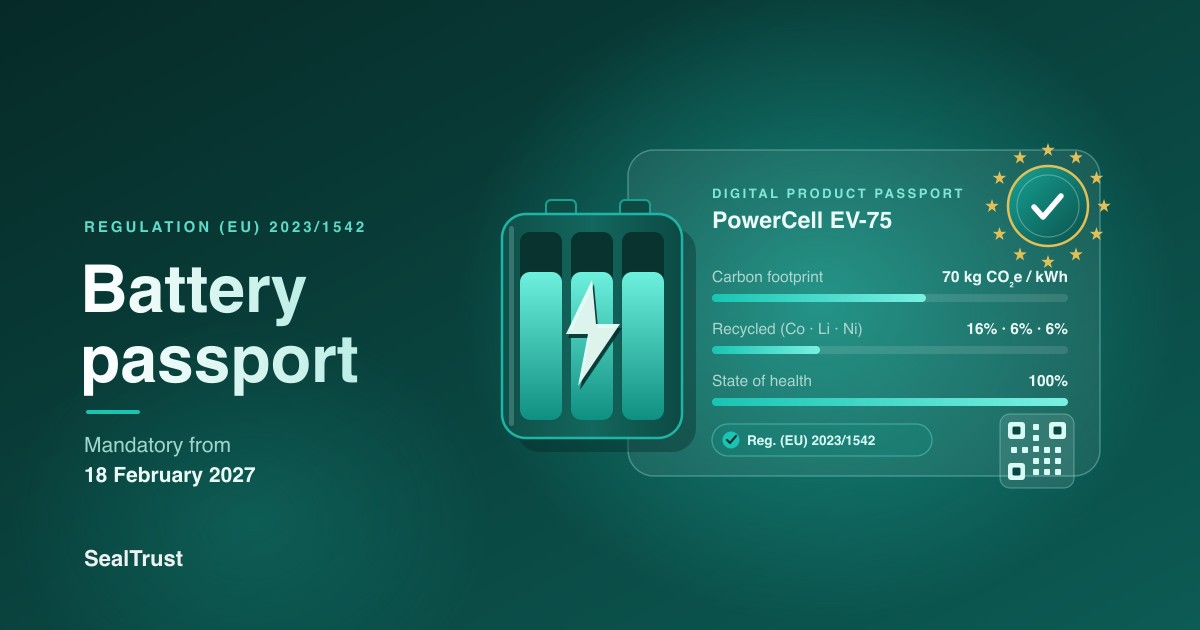
Brussels has already reached that conclusion. Regulation (EU) 2023/1542 creates the battery passport, a structured digital identity that carries composition, performance, safety and lifecycle data, and it is expected to become mandatory in February 2027. From that point, every battery sold in the Union will need a digital identity that can be read and verified.
The regulation settles what a battery has to declare. It leaves open the harder question, the one that actually matters for safety: how do you stop a counterfeit from carrying a copied passport the same way it copies a printed label today.
Tying the proof to the physical cell
That question is where our work begins. A battery or pack protected with SealTrust receives a secure NFC identity built on an NTAG 424 DNA chip, and that chip generates a fresh cryptographic proof each time it is scanned. The proof cannot be replayed or lifted onto another unit. A quick tap with a phone tells a retailer, a fleet operator or the person at home whether they are holding a genuine registered battery or an impostor, well before it goes on charge.
- Authenticity: a cryptographic proof checked on every scan and anchored publicly on the Base blockchain, so anyone can verify it independently.
- Safety data: the battery passport, structured in the European Digital Product Passport format and tied to that same verified identity.
- Traceability: origin, certification references and lifecycle events that stay attached to the cell for its entire life instead of living on a label that can be reused.
A certification only keeps people safe if it cannot be forged. Give each physical battery an identity that anyone can verify in a second, and the certification stops being a sticker you have to trust and becomes a proof you can check. For the manufacturer there is a second gain, since fakes trading on its name, and its liability, get much harder to pass off.